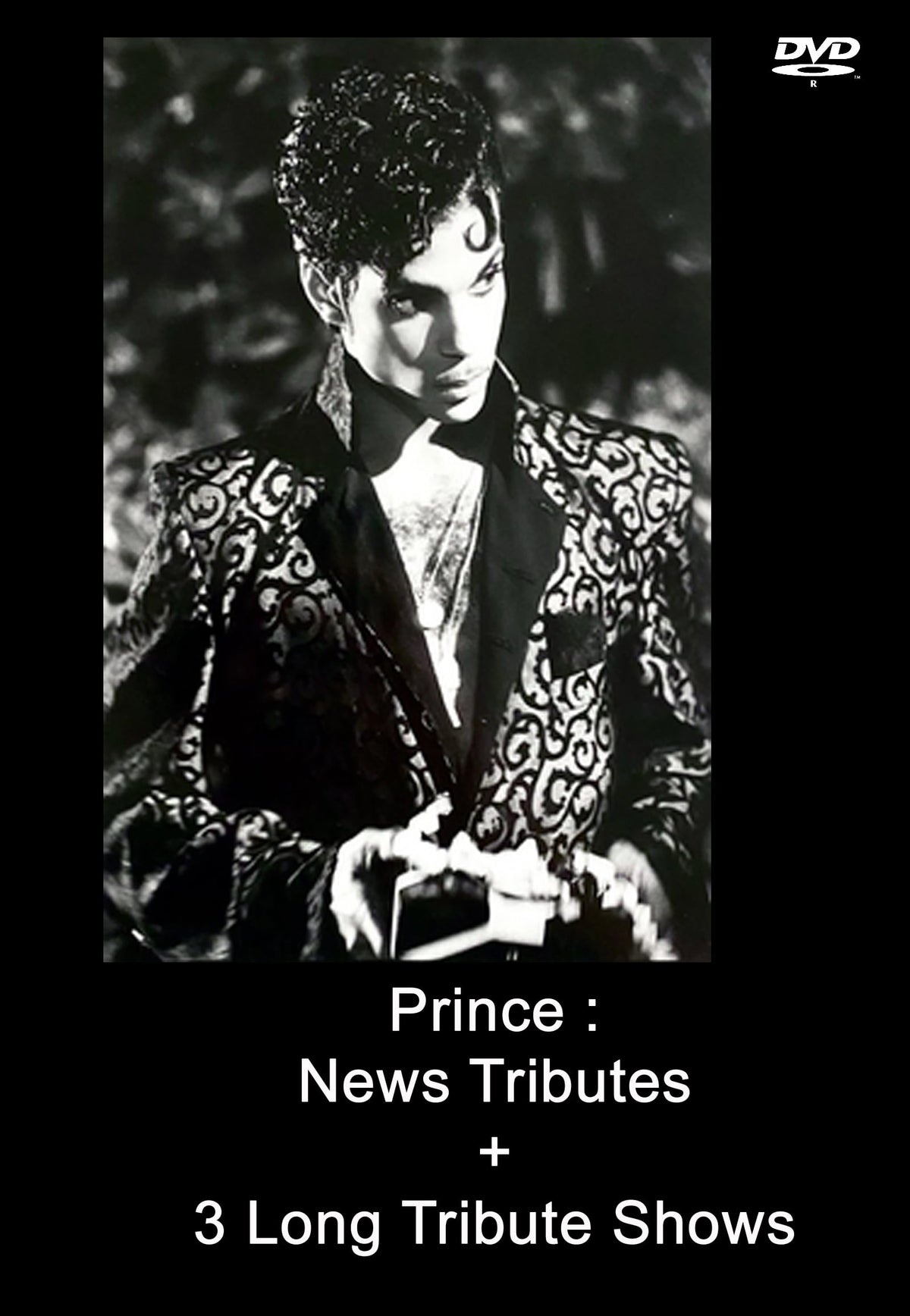
Prince / News Tributes + 3 Long Tribute Shows (2DVDR)
Prince / News Tributes + 3 Long Tribute Shows (2DVDR)
DVDR 1: News Tributes
〇 Barack, Stevie, Sheila, and Carmen (52 mins)
Barack Obama - Jimmy Fallon - Stevie Wonder - Tamron Hall - Sheila E. & CeeLo - Stevie Nicks
〇 Dez, Lenny, will.i.am, and others (1 hr)
Dez Dickerson - Bebe Winans - Don Lemon & Van Jones - Lenny Kravitz - will.i.am - The View
〇 Jimmy, Bootsy, Ellen, and more (1 hr)
Jimmy Jam - George Lopez - Bootsy Collins - Ellen DeGeneres - Mint Condition - Mint Condition / "She's Always In My Hair"
〇 Taja and others (44 mins)
Taja Sevelle - Democracy Now! - KSTP - Newsnight (UK) - The One Show (UK)
〇 Life & Death of an Icon (NBC Dateline) (40 mins)
〇 Australian Arts Channel Tributes (30 mins)
〇 Prince: The Legend, The Mystery (ABC 2020) (37 mins)
〇 Dr. Drew Special (17 mins)
〇 Sky News Special: End of the Purple Rain (24 mins)
DVDR 2: 3 Long-form Tribute Shows
〇 The Man Behind the Music (1 hr 20 mins)
〇 Prince Reflection: Celebrity Panel 2016 (87 mins)
〇 The Grief Disco (3-hour BBC radio tribute featuring fan anecdotes and celebrity tweets)
This collection of Prince tributes is compiled across two DVDs.
The first disc, "News Tributes," gathers memorial coverage and special programs from major media outlets in the U.S. and the U.K. that aired immediately following Prince’s sudden passing. It includes a statement from former President Barack Obama, tributes from stars such as Stevie Wonder and Lenny Kravitz, and a performance by the band Mint Condition.
"Life & Death Of An Icon" is a one-hour special that aired on NBC’s *Dateline* the day after Prince’s death. Hosted by Lester Holt, the program covers the events leading up to his passing and the investigation at Paisley Park, while also reflecting on his life and musical achievements through rare archival interviews and testimonials from those who knew him.
"Australian Arts Channel Tributes" features a documentary broadcast on an Australian arts-focused channel, exploring Prince’s life, his accomplishments, and the circumstances surrounding his sudden and mysterious death.
Also included is a special documentary that aired on ABC’s *20/20* the day after his passing. It examines his final days and the public reaction, while looking back at his career. The program touches on his struggles with record labels over master recording rights and his life as a vegetarian, featuring tributes from figures like John Mayer that honor his remarkable legacy.
The "Dr. Drew Special" includes a deeply moving segment featuring Van Jones—a close friend of Prince—who, while overcome with emotion, speaks not only to Prince’s greatness as a musician but also to his personal warmth and his extensive, often quiet, philanthropic work. "Sky News Special: End of the Purple Rain" is a special tribute documentary that aired on the British news network Sky News following Prince’s sudden passing on April 21, 2016.
DVD 2 features three extended tribute programs. The first, "The Man Behind The Music," is a documentary that originally aired on the American network REELZ in 2016, exploring Prince’s life and achievements. Through interviews with music critics and early band members, it examines the many facets of his persona—from the establishment of the "Minneapolis Sound" and his fight for artists' rights to his philanthropic endeavors. (Please note: There are no subtitles, including Japanese.)
"Prince Reflection: Celebrity Panel 2016" captures a memorial roundtable discussion held at New York University in May 2016, shortly after Prince’s death, featuring a group of prominent creative figures. These individuals—all of whom shared a close personal connection with Prince—gather to share passionate insights into the "real" man behind the genius and his enduring musical legacy.
Director Spike Lee recounts a memory of playing an intense, one-on-one basketball game with Prince on the indoor court at Paisley Park. He reveals a side of the artist that fans will love to see: Prince was a "legit" player, skillfully executing moves like through-the-legs dribbles and backhand passes. Lee, himself a well-known basketball fanatic, humorously admits that he was soundly defeated by Prince.
Questlove, a devoted Prince superfan, highlights the 1-minute-23-second track "Sister" as an example of the artist's extraordinary expressive range—remarking that no other musician could so perfectly capture such a vast spectrum of emotions—from confusion to rage—in under 90 seconds. Anthony Hamilton recounts that back when he was a backing vocalist for D’Angelo, the two were once invited by Prince to a jam session. However, because Prince enforced a strict policy at his studio and parties—requiring only healthy food and strictly prohibiting alcohol—D’Angelo turned down the invitation, remarking, "No booze and no meat? You’ve got to be kidding me!" Hamilton himself later had the chance to perform with Prince following an awards ceremony. "It was an incredible stage, with Questlove on drums and Stevie Wonder on keyboards. Prince walked over to me and asked, 'Hey, why don't we make some real noise?' Naturally, I said yes!" Hamilton recalls this as a supreme memory, noting that he went on to perform with Prince about eight times in total.
Alan Light shares an account of his first interview with Prince—for a *Vibe* magazine cover story—highlighting the "profound words" that only a true genius could utter. During a soundcheck before a show in San Francisco, Prince invited Light onto the stage. As Light struggled to keep his composure, Prince—while playing a guitar solo—suddenly approached him and asked, "Do you have any idea how grueling and difficult it is to be at a level where you can play *anything* you want—anything you can hear in your head?" This striking remark offers a glimpse into the loneliness and anguish of a genius who possesses the ability to execute everything with absolute perfection.
Touré, much like director Spike Lee, shares an anecdote about playing basketball with Prince in a private setting. The discussion offers a sharp analysis and testimony regarding Prince—noting that he was not merely gifted at sports, but possessed a cool, calculating playing style that allowed him to seize control of the game. This trait—the ability to anticipate an opponent’s moves and dominate them—was a reflection of his core personality, manifesting both on and off the sports field.
Kimbra reveals that she drew immense inspiration and courage from the way Prince completely erased the boundaries between "pop music" and "experimental music." A genius who embraced contradictions, Prince could display a wild, frenetic intensity and explosive energy one moment, only to reveal an exquisitely graceful and sensual side the next. He moved fluidly across the lines of masculinity and femininity, while his lyrics explored both the primal nature of human sexuality and the divine. Although the music industry and the public often seek to confine artists to a single "genre," Prince never pandered to them, nor did he ever allow his own art to be censored. Expressing deep gratitude as a fellow creator, Kimbra notes, "We embraced him not as a 'brand,' but as an entire 'musical universe.' Because of him, I gained the freedom to explore the many facets of my own identity."
The moderator, Professor Jason King, focused the discussion on how Prince dismantled and redefined the commercial and business rules of the music industry. He touched upon Prince’s fierce battle against major record labels in the 1990s—including his act of protest by writing the word "SLAVE" on his cheek—as well as the business-related motivations behind his repeated name changes. The analysis highlights how Prince’s persistent insistence that artists should own the master recordings of their own music laid the groundwork for the awareness of artists' rights in today’s era of digital distribution. While some at the time dismissed his behavior as "eccentric" or "self-indulgent," he is now highly regarded as a "revolutionary in business"—someone who, quite literally at the risk of his own life, challenged the exploitative structures of the music industry.
Carol Cooper offers a sharp analysis of Prince’s cultural achievements, contextualized within the social landscape of the United States during the late 1970s and 1980s—a time when American radio and music media were strictly segregated along racial lines. Prince, however, managed to bridge these divides: while remaining deeply rooted in Black funk, he also channeled the fierce, guitar-driven energy of Jimi Hendrix and incorporated elements of New Wave. Cooper notes that Prince "completely shattered market segmentations based on race and gender, relying solely on the sheer power of his musicality and visual presence." She describes the world he created as a visionary utopia—one that was perhaps too far ahead of its time—where people of all races and sexual orientations could come together, free from boundaries, to share in the excitement.
*The Grief Disco*, a tribute produced by the BBC, consists primarily of audio, but it is supplemented by visuals—including tweets from prominent figures about Prince—that make it an invaluable archival resource.
Couldn't load pickup availability
Low stock: 2 left